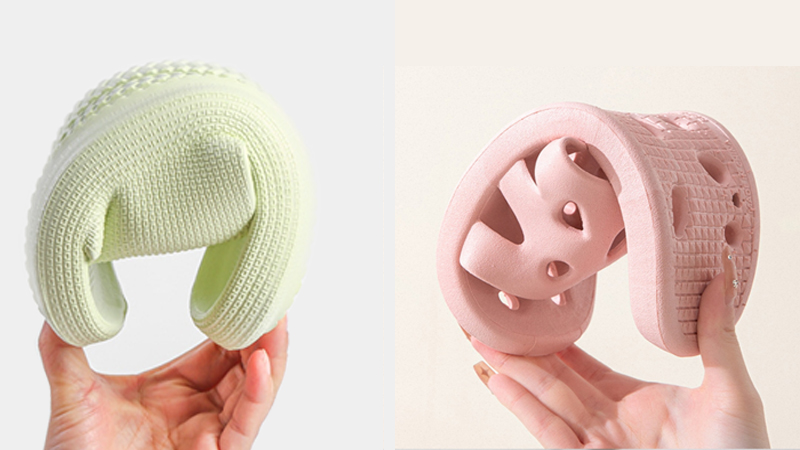
When wholesale buyers compare entry-level slipper materials, EVA and PVC are usually the first two options on the table.
Not because they serve the same purpose. They do not.
But in real OEM and wholesale work, buyers often compare them because both materials are widely used in molded slippers, bathroom slippers, household slippers, and mass-market product lines.
The real question is not whether EVA or PVC is universally better.
The real question is which one fits your target price, comfort level, customer expectations, and usage scene more effectively.
Featured Snippet
EVA and PVC are two of the most common slipper materials used in wholesale and OEM production. EVA is usually lighter, softer, and more comfort-focused, while PVC is usually cheaper, more waterproof-oriented, and better suited to budget bathroom or public-use slippers. The better choice depends on your target price, comfort requirements, and usage environment.
For a broader material overview, see our complete guide to slipper materials. If you want the full material-side explanation first, read What Is EVA Material in Slippers? Properties, Manufacturing & OEM Guide and What Is PVC Material in Slippers? Advantages, Disadvantages & OEM Guide. If wet-floor grip and outsole safety are a bigger concern, also see Rubber Sole Slippers: Durability & Anti-Slip Benefits.
EVA vs PVC Slippers: Quick Overview
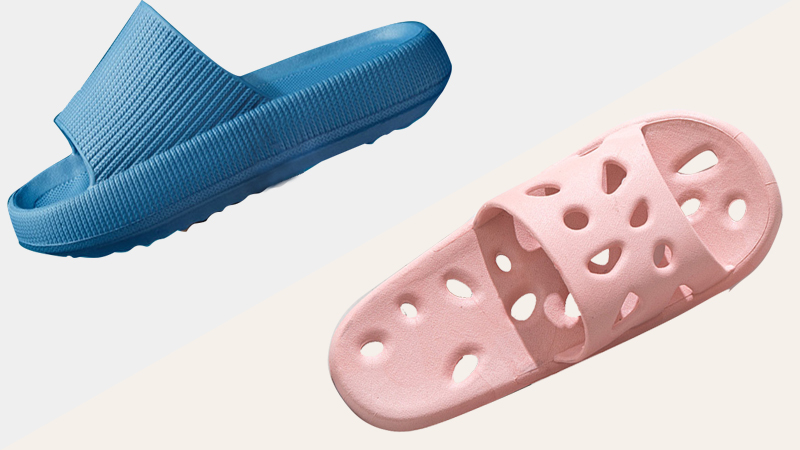
EVA and PVC are both common in large-volume slipper manufacturing, but they usually solve different commercial problems.
In simple terms:
- EVA is usually chosen for lighter weight, softer feel, and better comfort
- PVC is usually chosen for lower cost, easy waterproof use, and basic mass-market supply
This is why wholesale buyers often use them differently:
- EVA for comfort-led indoor slippers, casual slides, and better user experience
- PVC for budget bathroom slippers, public-use programs, and cost-sensitive volume orders
Quick Comparison Table
| Factor | EVA | PVC |
|---|---|---|
| Weight | Lighter | Heavier |
| Comfort | Better | Basic |
| Material feel | Foam-like | More plastic-like |
| Cost | Usually higher | Usually lower |
| Waterproof use | Good | Strong |
| Long wear comfort | Better | Weaker |
| Common fit | Comfort-led slippers | Budget bathroom or public-use slippers |
For the full material breakdown, continue with What Is EVA Material in Slippers? Properties, Manufacturing & OEM Guide and What Is PVC Material in Slippers? Advantages, Disadvantages & OEM Guide.
Material Feel: Which One Feels Better on Foot
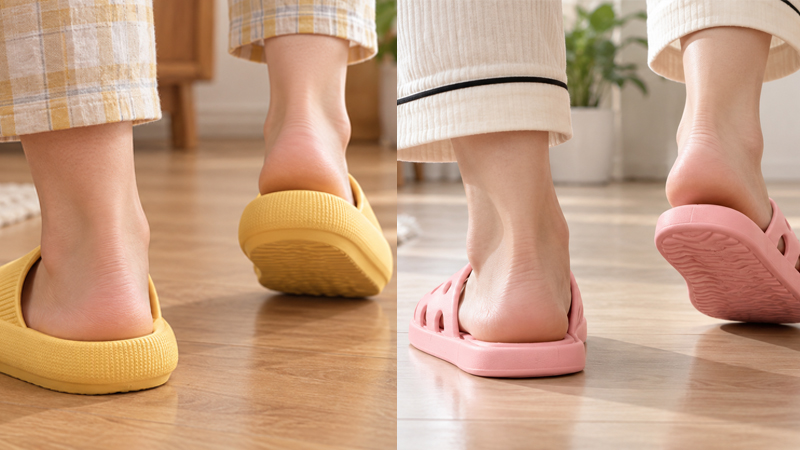
One of the biggest differences between EVA and PVC is how they feel in actual use.
EVA Usually Feels Lighter
EVA is a foamed material, which is one reason it usually feels much lighter than PVC.
In practical buyer terms, that means:
- easier all-day wear
- better suitability for casual home use
- stronger appeal for travel or lightweight slide categories
- more attractive shipping weight in some logistics scenarios
For brands selling to markets where users expect lightweight footwear, EVA usually has the advantage.
EVA Usually Feels Softer and More Elastic
EVA is usually:
- softer
- springier
- more cushioned
- less tiring over longer wear
That is one reason EVA is often preferred for:
- comfort-led home slippers
- casual slides
- hotel comfort slippers
- recovery-style or long-wear indoor slippers
PVC Usually Feels Harder and More Plastic-Like
PVC usually feels:
- firmer
- cooler to the touch
- heavier
- more rigid underfoot
Even when softened, PVC still usually feels closer to plastic than foam.
That is not always a problem. In short-wear, quick-on/quick-off, and highly budget-driven products, buyers may accept that trade-off.
EVA Is Usually Better for Long Wear
If the end user will wear the slipper for longer periods, EVA is usually the safer choice.
That includes:
- homewear
- indoor daily use
- hotel guest comfort
- casual walking indoors
- comfort-first retail lines
PVC is more acceptable in short-duration scenarios such as:
- bathroom use
- shower use
- temporary public-use slippers
- budget mass-market programs
Feel Comparison Table
| Feel Factor | EVA | PVC |
|---|---|---|
| Weight | Lighter | Heavier |
| Softness | Higher | Lower |
| Rebound | Better | More limited |
| Long-wear comfort | Better | Weaker |
| Barefoot feel | Softer and warmer | Cooler and more plastic-like |
| Typical positioning | Comfort-led | Budget-led |
For the full EVA material explanation, continue with What Is EVA Material in Slippers? Properties, Manufacturing & OEM Guide.
Cost Comparison: Which One Is Better for Budget Control
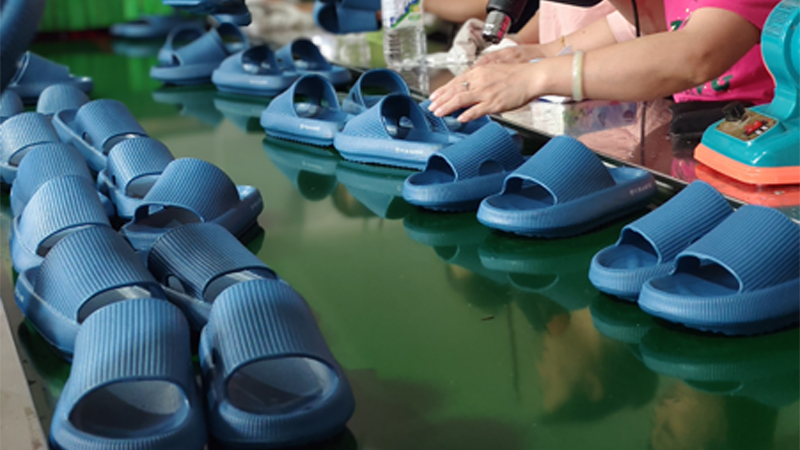
In wholesale, cost matters. That is one reason PVC remains highly relevant.
PVC Is Usually Cheaper
In many sourcing environments, PVC usually has a lower raw material and entry-level production cost than EVA.
That makes PVC attractive for:
- budget retailer programs
- supermarket value lines
- public-use slippers
- promotional projects
- low-price marketplace listings
- basic bathroom slippers
For buyers under strong unit-price pressure, PVC can be the more commercially practical starting point.
EVA Usually Costs More, but Buyers Still Choose It
Even when EVA is more expensive, many buyers still prefer it because it can reduce other problems later.
Common reasons include:
- better user comfort
- fewer odor complaints
- stronger perceived quality
- lighter shipping weight in many cases
- more suitable fit for mid-range retail positioning
So while PVC may win on lowest entry price, EVA often wins on sellability, customer satisfaction, and brand positioning.
Wholesale Is Not Only About Piece Cost
For international buyers, especially those selling into North America, Europe, Latin America, or quality-sensitive Asian markets, the lowest material cost is not always the lowest total cost.
A cheaper slipper can still become more expensive if it creates:
- refund pressure
- smell complaints
- low review scores
- low repeat purchase rates
- weaker brand perception
Buyer Logic Table
| Buyer Priority | Better Starting Point |
|---|---|
| Lowest cost | PVC |
| Better comfort | EVA |
| Better brand image | EVA |
| Budget bathroom line | PVC |
| Mid-range retail comfort line | EVA |
| Promotional bulk programs | PVC |
| Hotel comfort upgrade | EVA |
For the lower-cost waterproof route, continue with What Is PVC Material in Slippers? Advantages, Disadvantages & OEM Guide.
Waterproof and Bathroom Use: Which One Performs Better
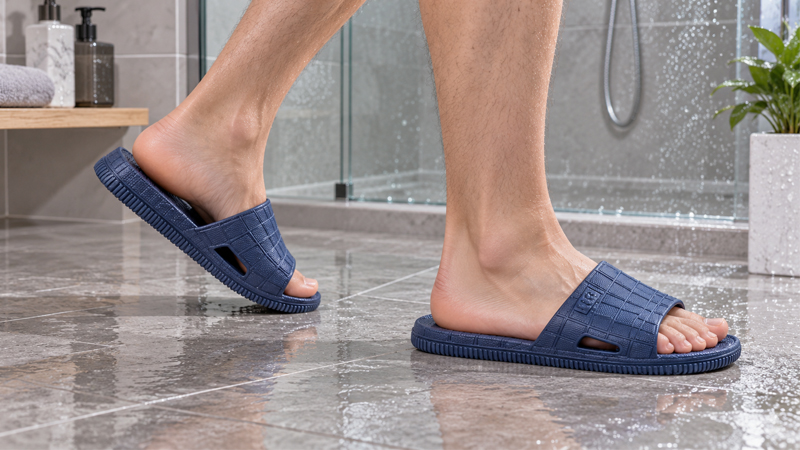
Bathroom use is one of the most common reasons buyers compare EVA and PVC.
But there is an important point many buyers miss:
Waterproof and anti-slip are not the same thing.
Both EVA and PVC Can Be Used in Waterproof Slippers
Both materials can be used for bathroom and shower slippers.
That is why both are common in:
- shower slippers
- bathroom slippers
- poolside slides
- spa changing-room slippers
- budget waterproof household slippers
EVA Usually Dries Faster and Feels Better
EVA is often preferred when buyers want:
- lightweight waterproof slippers
- faster-drying performance
- softer underfoot comfort
- less “cold plastic” feel
This is why EVA is often stronger in comfort-led bathroom or casual indoor-outdoor use.
PVC Is Common in Budget Bathroom Slippers
PVC is still very common in bathroom and public-use slippers because it is:
- low cost
- easy to mold
- practical for basic waterproof use
- efficient for high-volume programs
That makes it a strong choice when comfort is not the main priority.
Neither Material Is Automatically the Best for Wet-Floor Safety
This is one of the most important sourcing points in the whole article.
- EVA can still feel slippery on wet surfaces if the outsole design is poor
- PVC can also become risky on wet or soapy floors if the tread pattern is weak
So if the project is truly safety-led, the buyer should not judge only by material name. In bathroom-focused sourcing, that is exactly why many buyers move from a simple EVA-vs-PVC comparison to a more outsole-focused question such as PVC vs Rubber Bathroom Slippers: Which Has Better Anti-Slip Performance.
In many serious anti-slip projects, buyers eventually compare both materials against Rubber Sole Slippers: Durability & Anti-Slip Benefits.
Bathroom Use Summary
| Bathroom Need | EVA | PVC |
|---|---|---|
| Waterproof use | Good | Good |
| Comfort | Better | Weaker |
| Fast dry feel | Better | Basic |
| Budget entry price | Weaker | Better |
| Basic anti-slip | Depends on design | Depends on design |
| Soapy-floor safety | Not guaranteed | Not guaranteed |
If wet-floor safety is the main question, this topic will later connect naturally to PVC vs Rubber Bathroom Slippers: Which Has Better Anti-Slip Performance.
Production and OEM Efficiency: Which One Is Easier for Bulk Orders
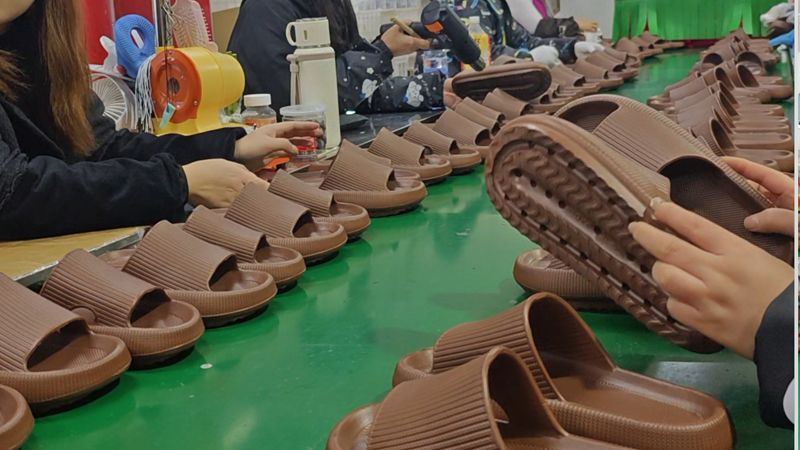
From a factory and OEM point of view, both EVA and PVC are widely used in large-volume slipper production. But they are often used for different commercial goals.
PVC Is Strong in Budget Bulk Programs
PVC works well for:
- simple molded structures
- budget-focused products
- large-volume replenishment
- repeatable low-cost programs
That is one reason it stays common in high-volume public-use and mass-market supply.
EVA Is Strong in Comfort-Led Bulk Programs
EVA also performs well in large production systems, but its commercial role is often different.
EVA is more often chosen when buyers need:
- better wearing comfort
- lighter product weight
- stronger retail acceptance
- more consumer-friendly feel
- better positioning for casual or lifestyle use
Standardization vs Perceived Upgrade
A useful way to think about it is this:
- PVC often fits standardized budget volume
- EVA often fits scalable comfort-led volume
So both are suitable for wholesale, but they serve different wholesale strategies.
OEM Mold Logic
For international buyers, mold cost should be judged by:
- product complexity
- number of sizes
- mold cavities
- texture detail
- output expectations
- ownership of the mold
Material alone does not always decide whether the mold is expensive.
In practice:
- EVA mold projects may require more attention to foaming behavior and dimensional control
- PVC mold projects may require stronger temperature control and attention to corrosion-related maintenance in some production environments
The real buyer takeaway is:
do not assume EVA molds are always more expensive or PVC molds are always cheaper. Ask for the actual mold quote based on the real product structure.
OEM Practical Advice
- Ask whether the style uses an existing factory mold or a new mold
- Clarify who owns the mold
- Confirm whether different sizes mean separate molds
- Ask whether future orders can reuse the same mold without extra tooling charges
- Calculate mold cost per pair based on your expected volume
Common Complaints: EVA vs PVC in Real Buyer Feedback
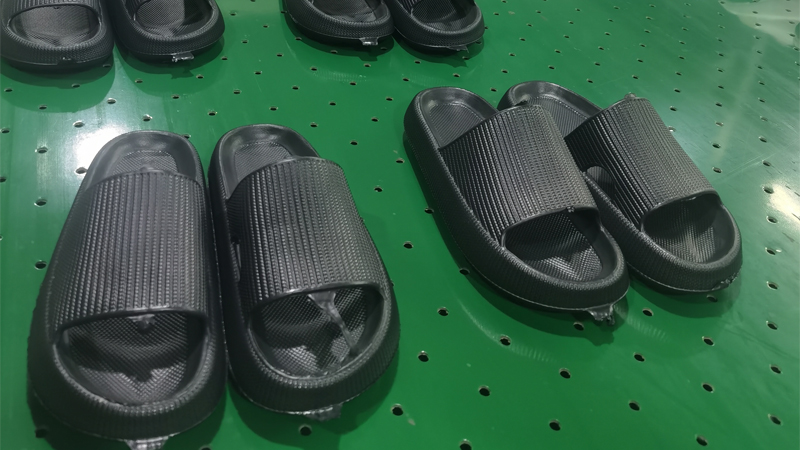
EVA and PVC do not generate the same type of complaints.
That is important for wholesale buyers, because material selection affects not only cost, but also refund risk and customer satisfaction.
Common EVA Complaints
EVA complaints often relate to softness and long-term structural performance, such as:
- too soft and lacking support
- outsole wears faster
- compression over time
- weak stability if density is too low
- poor grip if the tread design is weak
- some odor buildup after long indoor use
EVA problems are often comfort-structure problems, not severe material-smell problems.
Common PVC Complaints
PVC complaints are usually more direct and more visible to end users, such as:
- strong odor
- too hard underfoot
- slippery in soapy water
- cold and uncomfortable feel
- yellowing or sticky surface aging
- cracking or brittleness in cold environments
PVC problems are often material-feel and odor problems, especially in lower-grade products.
Complaint Comparison Table
| Material | Common Complaint | Typical Cause |
|---|---|---|
| EVA | Too soft | Density too low or over-soft positioning |
| EVA | Compression over time | Lower durability in high-use scenes |
| EVA | Weak grip | Poor outsole pattern design |
| PVC | Strong smell | Low-grade additives or recycled material |
| PVC | Too hard | Cost-driven formulation |
| PVC | Slippery in soapy water | Weak tread structure |
| PVC | Cold-weather cracking | Weak low-temperature performance |
| PVC | Yellowing or stickiness | Aging and material instability |
Which Complaint Type Is Easier to Manage
In many wholesale situations:
- EVA complaints are often easier to improve through density, hardness, and outsole design adjustments
- PVC complaints, especially odor complaints, can be harder to fix cheaply without materially upgrading the formulation
That is one reason many comfort-led buyers say:
If the goal is stable user satisfaction, EVA is often the safer choice.
Which One Is Better for Different Wholesale Scenarios
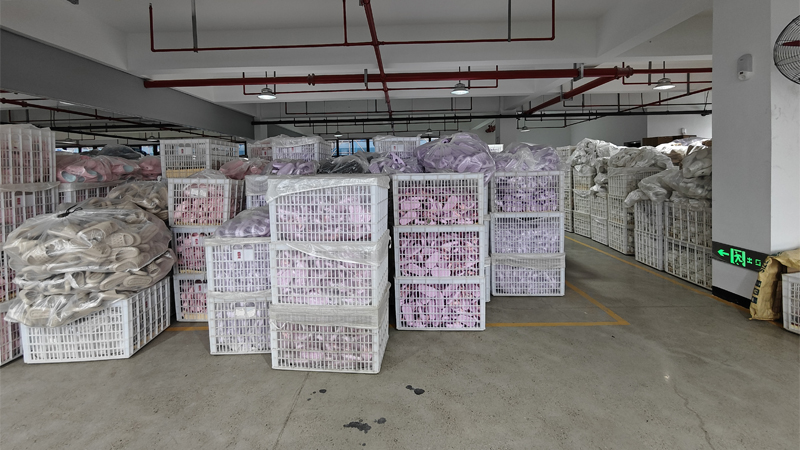
This is where the comparison becomes most useful.
The answer depends on what kind of wholesale project you are building.
Scenario Guide
| Wholesale Scenario | Better Starting Point | Why |
|---|---|---|
| Budget retail slippers | PVC | Lower unit cost |
| Supermarket value line | PVC | Easier low-price positioning |
| Hotel comfort slippers | EVA | Better guest experience |
| Public-use high-loss slippers | PVC | Cheaper replacement logic |
| Casual slides | EVA | Better comfort and lighter feel |
| Comfort homewear | EVA | Softer and more wearable |
| Travel slippers | EVA | Lighter and easier to pack |
| Shower slippers | Depends | Both work, but tread design matters |
| Cross-border low-price listing | PVC | Lower entry price |
| Mid-range retail comfort line | EVA | Better perceived quality |
Hotel and Hospitality
If the goal is guest comfort and user impression, EVA usually performs better.
PVC may still work for low-cost public-use or temporary-use programs, but EVA is usually stronger when comfort matters.
Budget Bathroom and Public-Use
If the goal is to hit the lowest workable cost, PVC often makes more sense.
This is especially true when the slippers are:
- short-use
- easy to replace
- not expected to feel premium
- supplied in high volume
Casual Retail and Comfort Homewear
If the product is meant to feel light, soft, and easy to wear, EVA is usually the better route.
Travel and Cross-Border Shipping
When shipping weight matters, EVA often becomes more attractive. In many logistics setups, lighter weight can reduce cost pressure, especially in bulk export and some air-freight scenarios.
That does not mean PVC cannot be shipped efficiently. It means buyers should compare:
- actual weight
- carton packing quantity
- pairs per container
- freight cost per pair
And if the project later shifts from cost control to wet-floor durability and safety, buyers often continue the comparison through Rubber Sole Slippers: Durability & Anti-Slip Benefits.
When Should Wholesale Buyers Choose EVA
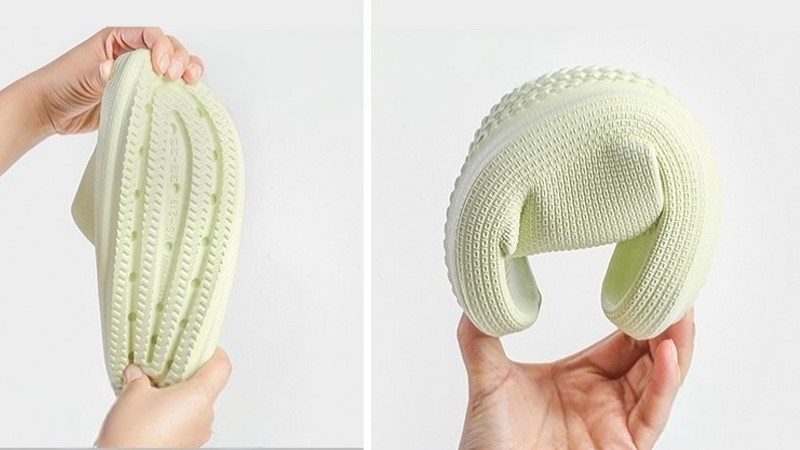
Wholesale buyers should usually start with EVA when:
- comfort is a major selling point
- light weight matters
- the slipper is meant for longer wear
- the market is quality-sensitive
- the buyer wants fewer odor-related complaints
- the product is aimed at casual retail, travel, hotel comfort, or homewear
EVA is often the better route for:
- casual slides
- home comfort slippers
- hotel guest slippers
- lightweight travel slippers
- mid-range private label programs
For the full material-side explanation, continue with What Is EVA Material in Slippers? Properties, Manufacturing & OEM Guide.
When Should Wholesale Buyers Choose PVC
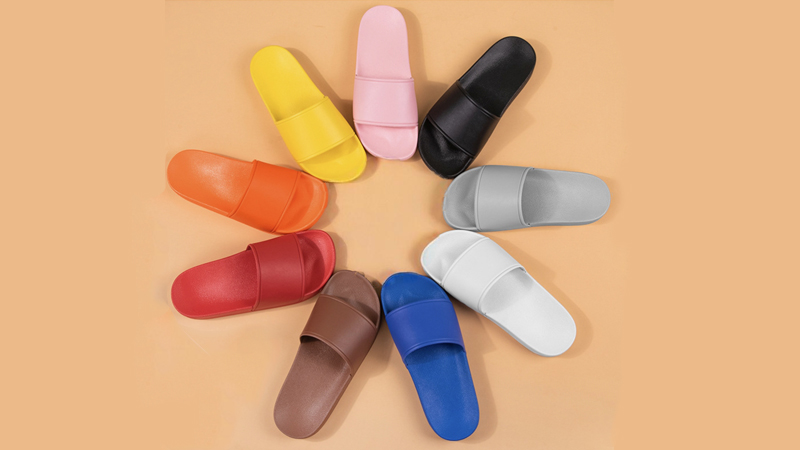
Wholesale buyers should usually start with PVC when:
- strict budget control is the first priority
- the slippers are intended for bathroom or public-use use
- comfort is secondary to price
- the project is highly volume-driven
- replacement cost matters more than premium feel
- the target market accepts a firmer and more plastic-like material feel
PVC is often the better route for:
- entry-level bathroom slippers
- public-use slippers
- low-price marketplace listings
- budget retail programs
- promotional bulk projects
For the full material-side explanation, continue with What Is PVC Material in Slippers? Advantages, Disadvantages & OEM Guide.
Is There a Middle Route? EVA/PVC Blended or Hybrid Solutions
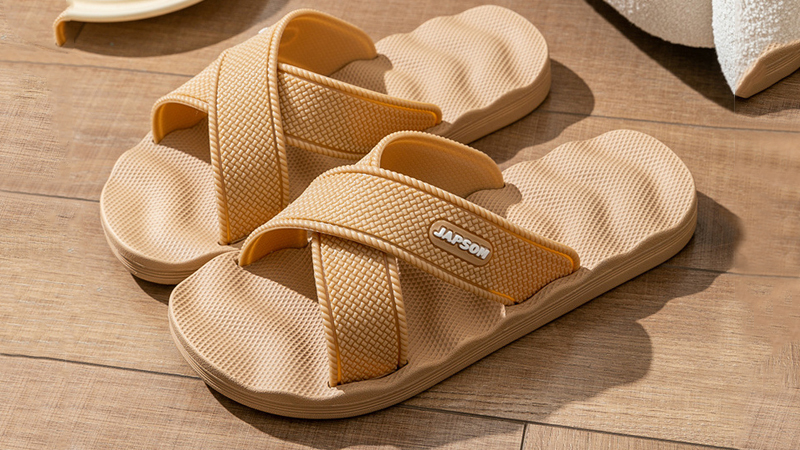
For some OEM buyers, the decision is not always pure EVA or pure PVC.
There is sometimes a middle route.
EVA/PVC Blended Approaches
In industrial practice, some manufacturers use blended or modified compound systems to balance:
- lighter weight
- better cushioning
- stronger hardness control
- improved wear performance
- more balanced cost structure
This kind of route can be attractive when the buyer wants:
- better performance than low-grade PVC
- lower cost than fully upgraded EVA programs
- a more balanced material story
- a step-up path from low-end to mid-range lines
Hybrid Logic Matters More Than Marketing
However, blended material is not automatically better.
It requires:
- good technical compatibility
- proper formulation control
- stable processing conditions
- clear supplier communication
If the factory cannot control the formula well, blended solutions may actually increase inconsistency.
Buyer Advice
For first-time OEM projects, pure EVA or pure PVC is often easier to control.
Blended or hybrid routes make more sense when:
- the supplier relationship is already stable
- sampling has already been validated
- the buyer clearly understands the trade-offs
- the target market really needs a middle solution
This logic will later connect naturally to EVA and Rubber Combination Sole Structure Explained from a broader hybrid-material perspective.
Conclusion
EVA and PVC are both important wholesale slipper materials, but they are not good at the same things.
EVA is usually better when the project needs:
- lighter weight
- softer feel
- better comfort
- stronger user satisfaction
- more mid-range retail or hotel positioning
PVC is usually better when the project needs:
- lower cost
- basic waterproof function
- high-volume supply
- budget bathroom or public-use logic
- low entry price
So the better choice is not universal.
If your goal is to build a more comfortable, easier-to-sell, and lower-complaint slipper line, EVA is usually the stronger starting point.
If your goal is to hit the lowest workable price for waterproof or public-use slippers, PVC can still be the more practical solution.
For broader material planning, return to our complete guide to slipper materials. For the material-side explanations, continue with What Is EVA Material in Slippers? Properties, Manufacturing & OEM Guide and What Is PVC Material in Slippers? Advantages, Disadvantages & OEM Guide. If you want to compare EVA with a more grip-focused outsole route, continue with EVA vs Rubber Sole: Which Is Better for Comfort and Durability. If bathroom safety is the bigger concern, continue with PVC vs Rubber Bathroom Slippers: Which Has Better Anti-Slip Performance. For the broader outsole logic, also see Rubber Sole Slippers: Durability & Anti-Slip Benefits.
FAQ
Is EVA better than PVC for slippers
EVA is usually better for comfort, lighter weight, and longer indoor wear. PVC is usually better for lower-cost bathroom or public-use slippers. The better choice depends on your product goal.
Are PVC slippers cheaper than EVA slippers
Usually yes. PVC is often chosen for lower-cost bulk production, while EVA usually costs more because it offers lighter weight and better comfort.
Which is better for bathroom slippers, EVA or PVC
Both can work for bathroom slippers, but they serve different needs. EVA usually feels lighter and more comfortable, while PVC is often used in lower-cost waterproof styles. For true wet-floor safety, tread design matters as much as material.
Which is better for wholesale, EVA or PVC
Neither is universally better. EVA is often stronger for comfort-led wholesale programs, while PVC is often stronger for budget-led wholesale programs.
Are EVA slippers more comfortable than PVC
Usually yes. EVA is generally lighter, softer, and more cushioned than PVC, which makes it better for longer wear and comfort-focused products.
Are PVC slippers more waterproof than EVA
Both can be used in waterproof slippers. PVC is often more common in budget waterproof styles, while EVA is often preferred when buyers want a lighter and more comfortable waterproof product.